| PDF version (653k) | ||||||||||||||||||||||||||||||||||||||||||||||||||||||||||||
SUPPLEMENTARY
PAGES FOR
SAMOAN PROVERBS*
*taken from Muagagana ma Tupua Fa'asamoa edited by the Bilingual/Bicultural staff, Department of Education, American Samoa.
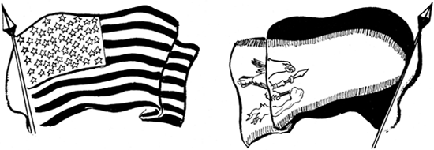
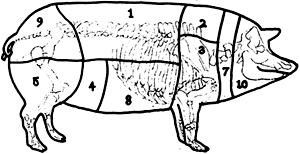
FLAG DAY Every year since April 17, 1900 when the American flag was first raised in American Samoa, the Samoans have been commemorating Flag Day. It is an important holiday in Samoa. Schools, organizations and villagers look forward to Flag Day all year. These groups participate in the singing, dancing, and marching. Representatives of these groups also participate and compete in the traditional games. These include basket weaving, coconut husking, making fire and playing cricket. There is also outrigger canoe racing for the strong men. Climbing coconut trees is a favorite of the young men. Chasing and trying to catch a greased live pig is a fun game for people of both sexes and all ages. Tug of war is also a lot of fun and a favorite among the heavy weights. People who are talented with their hands provide Samoan handicrafts and food. Displays of handicrafts alternate with food stands in long rows. The usual Samoan foods (taro, banana, chop suey, pork and palusami) are prepared and sold. Other favorites such as pisua, poi, fa'ausi and taufolo are made available for the hungry connoisseur. The beauty of Samoan Flag Day is that everybody has fun. All of the activities are held outdoors in a big open field. People of all ages, races and sexes take delight in observing and/or participating. It is a day of fun for the students away from all the studying. It's a day of sharing talents, exchanging jokes and promoting laughter. It's a day of cultural exchange and preservation. It's a day of coming together to share one's heritage as a Samoan. CHRISTMAS IN SAMOA Christmas is celebrated in Samoa as a Christian holiday. Churches are decorated with nativity sets. Homes are lighted with imported Christmas lights and decorated with artificial Christmas trees. Traditionally gifts were not given or exchanged on a individual basis. (This has gradually changed over the years as people adopt American culture.) Because of the Samoan extended family, gifts were given or exchanged on a family level. They usually consisted of food. The idea was to share the best food each family could provide. The eating of food was something that everybody could participate in and feel like a part of the family. Giving a gift on a one-to-one basis implies individualism versus group importance, possessiveness versus sharing and acquiring unnecessary material goods versus fulfilling the human needs for food and shelter. It was considered improper to give to only some of the family and not to all of the members. The emphasis was on maintenance of family relations and prevention of hard feelings. Material gifts are inevitably associated with their monetary value. As more and more Samoans adopt American culture, the buying of gifts has become a burden. This is far removed from the true intention of giving someone a gift because you care and because there is a need. The trend is to give to impress and not to express. Samoans continue to honor and respect Christmas as a holy day and not just a holiday. People attend services at the church of their choice. Afterwards, they gather together to eat or have a to'anai following which they rest. The entire village is beset by peace and tranquility. Most everybody goes to sleep or reads the Bible. Children love to take their mats and sleep under big shady trees. Now with the Western influence some families are seen celebrating Christmas by having a family picnic where people eat, drink, and have a merry time. PUA 'A Do you know the Samoan protocol for cutting parts of the pig? It is customary for pigs to be included in the food presentation at feasts and ceremonies. Pigs are prepared in order to honor a visitor, reciprocate a good deed or exchange good fortunes. Hardly any part of the pig is wasted. The heart is wrapped in a banana leaf and cooked. This is called "ofu fa'afaleolo" and goes to the high chiefs. The blood is also saved. It is mixed with fat and seasoning, wrapped in banana leaves, cooked, and given to the cooks. The cooks also get the intestines and the rest of the internal organs for their use. The liver is also wrapped in a banana leaf, cooked and given to the talking chief for his "meafono" (food set aside for later use by the chiefs). The pig is cooked to medium rare. This helps the man who cuts it to do the job with precision and speed. The portions given to the chiefs by protocol are not meant to be eaten at that time. They are "meafonos" for later use. The meat will be fully cooked at that time before consumption. Distribution of Pig 1.
Ivi tualä (Loin) 2.
Ivi 'ö'ö (Plate) 3.
Itu mea tele (Boston
butt) 4.
Alo (Flank) 5.
Älaga vae (Lower
Ham) 6.
Älaga lima (Picnic
Shoulder) 7.
Ivi muliulu (Neck
Bone) 8.
Itü pale sau (Bacon)
9.
Ivi nofoi (Upper
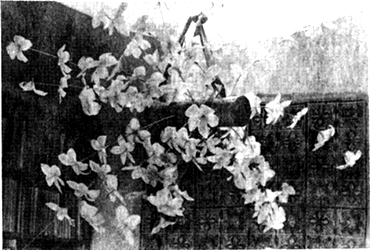
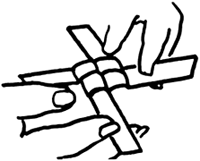
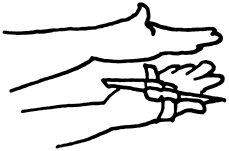
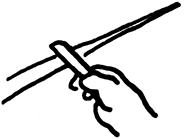
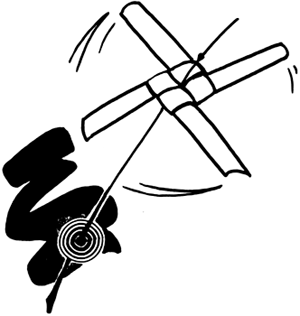
ham) 10. Ulu (Head) TEU PÄFA'I Mea e Fa'aaogäina: 1. Päfa'i 2. Pua (I Hawaii nei e tele fo'i isi itü'äiga fugälä'au e mafai ona 'e fa'aaogäina, e iai oketi, makelita, ma pua saina.) 3. Tuäniu (E tusa male 60 tuäniu na fa'aaogäina e fai ai le teu o lo'o i le 'ata. 'Ae mafai lava ona tele atu o tunäniu e te fa'aaogäina. 4. Seleulu. Fa'atonuga: 1. Tipi muamua le päfa'i i le umï e te mana'o ai. 2. Fa'aaogä le seleulu e tatipi a'i muli tuäniu ina ia ma'ai ma fa'afaigofie ai ona tatui 'i le päfa'i. 3. Tatui pua 'i tuäniu, fa'avävä pua i sina tasi inisi. 4. Tatui tuäniu 'ua iai pua 'i le päfa'i. E mafai lava ona fa'au'umi o isi tuäniu ae fa'apupu'u isi. Ina ia lelei ma mänaia lau teu. 5. Fa'ata'amilo atoa le tatuiina o tuäniu ma pua i le tino o le päfa'i ina ia päleni felei. A lë tü lelei le päfa'i, lalago i nai ma'a ona täofi mau ai lea. Nai manatu fesoasoani: O tätou Sämoa e fiafia tele fo'i e fai teu päfa'i e teu a'i lumäfale o fale. Pe tautau i tulutulü o fale e pei ona fa'äalia i luga. E aogä fo'i teu päfa'i e teuteu ai totonu o falesä, po'o luga fo'i o laulau pe'ä fai ni 'aiga fiafia. E lëai Se tupe e alu ai. BANANA TRUNK ARRANGEMENT Things you need: 1. Banana trunk (cut to whatever height you desire). 2. Bag of plumeria flowers (you can also alternate plumeria with orchids, marigolds, Chinese plumeria, etc.). 3. Coconut stalks (if these are hard to find, you can substitute barbeque sticks). We used about 60 regular coconut stalks for the pictured arrangement. You can use more or less, it's up to you. 4. Scissors. Instructions: 1. Cut the banana trunk to the size you want. 2. Use the scissors and cut the thick ends of the stalks to make sharp points. This will make it easier for you to stick the stalks to the banana trunk. 3. Insert the stalks into the plumeria flowers and space them about one inch apart. 4. Stick the pointed end of the stalk with the flowers into the banana trunk. You can shorten some of the stalks to give a full look to your arrangement. 5. Stick stalks and flowers all around the banana trunk to maintain balance. If the trunk is not steady in the upright position, simply hold it in place some rocks. Suggestions: You can use only plumeria flowers to make your arrangement as in the picture, but you can also alternate the plumeria with orchids, marigolds, etc. The size of the banana trunk is up to you. You can shorten some banana trunks, tie two pieces of ropes on each end, stick coconut stalks with flowers to the trunk and hang as shown in the illustration. The Samoans like to make banana trunk arrangement to decorate entrances to their homes. Similar arrangements are used to decorate altars in churches. Still some are used as centerpieces on tables for banquets. (With a little imagination and time, banana trunk arrangement can be beautiful. Most important, it can be made very cheaply compared to the prices in florists.) PE'A PE'A
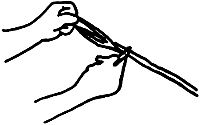
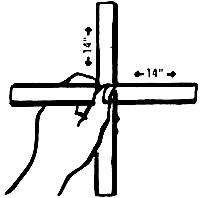
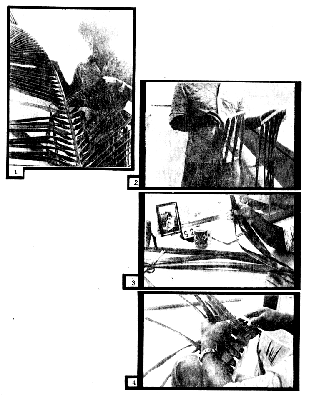
Instructions: Fa'atonuga: 1. Ia iai se fasi launiu. 2. Fa'aaogä se tama'i naifi, po'o le maiu'u
o lou lima matua, e fa'apü ai lalo ifo o le tuäniu. 3. Fa'asolo le naifi po'o lou maiu'u i le
umi atoa o le tuäniu se ia o'o lava i le si'usi'u o le launiu.
(ata #1) 4. Sasae ese lë tuäniu se'i fa'aaogä ise
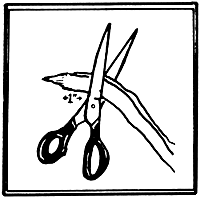
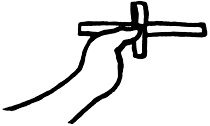
taimi o muamua. 5. Tago loa i le fasi launiu (o lo'o
pi'imau pea i lona itü lautelë) ma fua se inisi se tasi i le
itü lautelë, ona tipi ai lea i'inä. (ata #2) 6. Tago loa i fasi launiu e lua ua uma ona
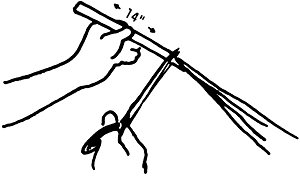
tipi ma fa'atütüsa lelei. 7. Fa'aaogä le vase e fua ai le sefulu-fä
inisi, amata mai i le itü na tipi muamua. (ata #3) 8. Fa'aaogä le seleulu, ma tipi tonu i le
mea e atoa iai le sefulu-fä inisi. 9. Ua iai nei fasi launiu tutusa e lua mo
le faiga o lau pe'ape'a. 10. Tago i fasi launiu nä e lua ma fai ai
se fa'akoluse. 11. Fa'aaogä lou lima matua ma lou
lima tusi e taofi a'i launiu. 12. Afe muamua ifo le fasi launiu pito aluga
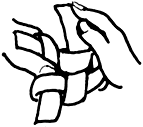
aga'i i le ogätotonu ma täofi i lou lima matua. (ata #4) 13. Fa'apenä fo'i ona faia i le fasi launiu pito i lalo. Repeat the same process with the bottom vertical piece. 14. Taofi fasi launiu e lou lima tauagavale
ae fa'aaogä lou lima matua ma lou lima tusi o lou lima taumatau
e afe a'i ma fa'aofi le pito o le fasi launiu taumatau i le
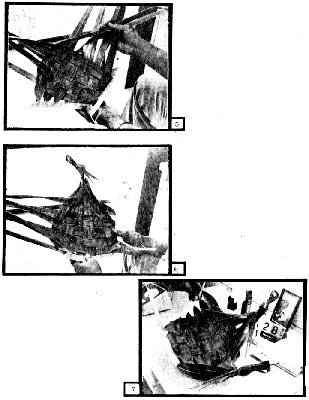
pü pito i luga. (ata #5) 15. Fa'apenä fo'i ona e faia mo le fasi launiu
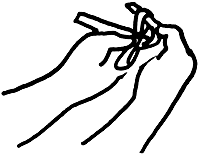
tauagavale, ma le pü pito i lalo. (ata #6) 16. Fa'aaogä lou lima matua taumatau ma fa'asolosolo
lemü ifo le pito o le fasi launiu pito i lalo aga'i i totonu
o le pü o lo'o i le itu taumatau. Täofiofi pito fasi launiu
e ou lima ne'i malepe pe matala. 17. Fa'apenä fo'i ona ë faia i le isi itü. 18. Fa'aaogä uma tama'ima'ilima e tosotoso
al ma täofiofi pito e fä o launiu seia tau lelei ma maua ai
le tino o le pe'ape'a. (ata #7) 19. Tu'u le pe'ape'a i le älofi, lima o lou
lima tauagavale, ae fa'aaogä le älofi lima o lou lima taumatau
e fa'apapa a'i. (ata #8) 20. Tago i le tuäniu ma fa'alämolemole lelei
i le naifi. 21. Nonoa se pona i le si'usi'u ole tuäniu. 22. Fa'aaogä le seleulu e 'oti fa'ama'äi
ai le itü mafiafia o le tuäniu. 23. Tui le itü na tipi i le ogätotonu o le
pe'ape'a. 24. Toso le tuäniu se ia tau i le pona. 25. "Uma" -- Manaia tele së la'u
pe'ape'a. (ata #9)
MAILO SAMOA Mea e tatau ona iai: 1. Fasi launiu se lua 2. Tama'i naifi ma'ai Fa'atonuga: 1. Sae muamua le launiu pei ona fa'a'alia i le ata #1. 2. Faitau ta'i ono launiu failä ma sasae, pe tipi i le naifi. 3. E tatau ona iai ni fasi launiu se lua e fai ai le mailo. (ata #2) 4. Muamua ona fa'ataoto lelei o le tasi itü launiu i luga o ou vae ('aao) po'o luga fo'i o se laulau. ('ata #3. Tilotilo i le fa'anumera ina o fasi launiu) 5. Afe i luga fasi launiu numera 1, 3 male 5; täofi fasi launiu ia e lou lima tauagavale. (ata #3) 6. Tago i le launiu lona lua ma fa'afa'alava i le itü taumatau o le launiu muamua. Amata lea i le fasi launiu #1, fa'afa'alava i le ogätotonu o le launiu muamua ma lalaga. (ata #4) 7. Tu'u i lalo fasi launiu numera 1, 3 male 5, ae afe i luga fasi launiu numera 2, 4 male 6. Fa'afa'alava mai iai le fasi launiu numera #2 o le itü lua ma lalaga. 8. Toe tu'u i lalo fasi launiu numera 2, 4 male 6, ae afe i luga fasi launiu numera 1, 3 male 5. Fa'afa'alava mai iai fasi launiu o le isi itü ma lalaga. E fa'apea ona faia se'i maa'a lelei fasi launiu e ono o le itü lua. (ata #5) 9. A mae'a ona lalaga o fasi launiu e ono, e taufelefele launiu pei o le ata #6. Tago lea e ao ta'i ono fasi launiu pei ona iai itü e lua ma nonoa, pe fa'apona e taofi a'i le mailo ia aua ne'i matala pe malepe. 10. UMA! Ua e iloa nei ona fai o se tasi o ipu aogä tele a Samoa e taua o le M A I L O! MAILO SAMOA Supplies or things you need: 1. Two pieces of palm leaves 2. Small sharp knife Instructions: 1. Split the palm leaf (picture #1) 2. Count six strands for each piece and cut with the knife. 3. You need two pieces of palm leaf to make the dish. (picture #2) 4. Take one piece of leaf and place it flat on either your lap or on a table. (picture #3. Notice the strands are numbered) 5. Lift strands number 1J 3 and 5; hold them with your left fingers. (picture #3) 6. Take the second piece of palm leaf and lay it to the right of the first. Take strand #1 of this 2nd piece and lay it across the first piece and plait. (picture #4) 7. Release strands 1, 3 and 5; lift strands 2, 4 and 6 of this same piece. Take strand #2 of the second piece and lay it across the first piece and plait to form checkerboard squares. 8. Keep releasing and lifting strands of the 1st piece in alternating manner, while criss-crossing them each time with a strand of the 2nd piece until all 6 strands are plaited. (picture #5) 9. After plaiting the 6 strands, the ends will stick out. Simply gather the 6 strands of the first piece and tie them in a knot. Do the same for the 6 strands of the second piece. (picture #6 and #7) 10. FINISH! You have just made one of the most useful and common art dish of Samoa... a M A I L 0!(Give yourself an A for trying) Samoan Games Samoan youngsters play many traditional Samoan games. Some of the games are only played by boys, others by girls. Many are familiar to both and make use of the natural things around them. These games are common on school grounds in Samoa but are often forgotten by Samoan children in Hawaii. 1. Fa'ase'ega is sliding down slippery rocks into the water or tobogganing down slopes with a lapalapa (midrib of a coconut palm). 2. Taupega is similar to the American swing. It is easy to weave the bark of the young fau tree into a rope and hang it from a branch of a mango tree. Children connect the two ends of the rope and sit on a flat object to protect them from rope burns. One person sits in the swing and the others push. They try to see who can swing the highest. 3. Täfue, jump rope, is also an easy and fun game to play. Usually little girls like to play täfue. They have two teams of five to eight girls. One team swings the rope made from the fau tree bark and the other team jumps. The object is to see which team can jump longer. 4. Taga ti'a or dart throwing is sometimes dangerous because of the speed with which the boys throw the darts. The darts are usually very sharp. Thin straight sticks are polished smooth so when they touch the ground they fly several more yards in the desired direction. There is no target but the object is to see whose dart goes the farthest. 5. Moa or tops are made from small newly formed coconuts (aile). Children stick a short piece of coconut midrib into the soft part of the nut. They spin it between the palms of their hands onto a smooth surface. The object is to see whose moa spins the longest. 6. Fa'alupe is equivalent to kite flying. Usually it is the boys who play fa'alupe. They take a leaf of the candlenut tree and tie a length of sinit ('afa) to the handle part of the leaf and let it fly on windy days. 7. Sapo or jacks is a favorite of little girls. They use stones or lama from the candlenut tree or even nails or marbles. Samoan girls use an orange or lemon for the ball. They throw it into the air and try to pick up the objects without moving the others. 8. Tapalega is played in the water by two players. Each has two big sticks (au tapale) one in each hand. There is one very lightweight stick (uto) floating on the surface of the water. The players strike near the floating uto and it flies into the air. Then they hit it toward the opposite goal (tini). The other player tries to defend his goal. When the uto reaches the goal the defending player brings it back into play and tries to get it across the opposite goal. 9. Veloveloga or wooden spear throwing is a popular game played by the male adults. Women join in the dancing and cheering. The competition is between two villages but the number of players is unlimited and each team enlists the help of relatives from other villages. The village where the contest is held plays the role of the host and supplies the food for all of the participants. Sometimes the contest lasts a week. The guests will have their turn to supply food when the game is played in their village. Cheering, singing and dancing is continuous during the games and into the evening. A heavy wooden spear is made from a straight branch which is barked and dried in the sun for two or three days. Points are scored by throwing spears farther than the farthest spear of the opposing team. Judges for each side collect the spears as they keep the score. The team that tallies 100 points first is the winner. Another way of playing the game is to throw the spears at a target made from the trunk of a young coconut tree. The leaves are stripped and the roots are cut off before the trunk is stuck into the ground. At least six feet appear above the ground. The number of spears found in the trunk determines the points for each team. Fa'ataupati is a fast moving dance which requires movements of the hands, legs and feet to the rhythm. This dance is usually done by muscular boys and men. The number of dancers varies from 2-10. It is done standing in a straight line. Throughout the dance the dancers bounce as they shuffle their feet alternately back and forth. 1. First the leader calls out "Nonu ä togi ä togi ë" and the others answer "Ë ë a togi ë". They repeat this again and after the second time everyone shouts "I a ï ai ä". 2. Next, lift the left foot behind and slap it with the right hand. Then kick the left leg forward and slap the knee with the right hand. Repeat. 3. As the foot hits the floor, quickly slap five beats (alternating hands) on the thighs. 4. Then quickly slap five beats with alternating hands on the chest. Clap once, pause and clap three times. 5. Repeat 3 and 4. (Remember to keep the feet shuffling!) 6. Shout "Alu se, alu se" while bending forward and striking towards the ground, first with the left fist, then with the right. 7. Turn completely around clockwise and then shout "Tui afë tui afë" again bending and striking with left and right fists. Spin around again, counterclockwise. 8. Repeat 6 and 7. 9. Hop five steps to the right, putting weight on the right leg and slapping the chest with alternate hands. Then hop five steps to the left with weight on the left leg and continue to slap chest. 10. Repeat entire dance from 2. To finish the dance, take two small jumps into the air and shout "Choo, choo, woo." Game
and Song about Shapes
1. Get ten or more students together and have them hold hands in a circle. As they sing the first verse they walk around clockwise. On the last line they should all swoop down and touch the floor. 2. For the second verse they form a square and move in and out making a smaller then larger square. Again they bend their knees and touch the floor on the last line. 3. Next they form an oval and move counter-clockwise as they sing. Swoop again on the last line. 4. Finally, they form a triangle and again move in and out making a smaller and larger triangle. On the final swoop they may wish to actually fall down if they are playing on grass or carpet. You should start the song and motions slowly but after everyone has learned the process, it is fun to speed it up and interchange the order of shapes. O Oe IsumuThis is a song about the cat and the rat. One day the cat came home and found that there was no food left in the kitchen. His good friend, rat, ate the food. Mr. Cat decided to chase after the rat, thinking when he catches her (rat) he will eat her for dinner. Now a days you find rats are very, very afraid of cats--rats are cats' enemies. Instructions Take 20 to 30 students outside in an open space. Each holding hands in a circle. Choose 2 children (boy and girl or same sex).One will be the cat, the other will be the rat. Have those two stand, outside the circle, about five yards apart. After the teacher says "go". Let the one who is the rat run, and the one who is the cat chase after him/her. The children let the rat enter the circle by letting go of each other's hands, but they try as hard as they can to keep the cat from getting into the circle. Keep repeating the song until the cat catches the rat, or until the two get tired and can't run anymore. You can choose two more children to do the same thing if you desire. tupua Agricultural Items - Samoa
Agricultural Items - English translation
Shelter and Household - Samoan
|
||||||||||||||||||||||||||||||||||||||||||||||||||||||||||||











 *Taken
from Muagagana ma Tupua Fa 'asamoa edited by the Bilingual/Bicultural
Staff, Dept. of Education, American Samoa
*Taken
from Muagagana ma Tupua Fa 'asamoa edited by the Bilingual/Bicultural
Staff, Dept. of Education, American Samoa O
ä fitafita e 'ofu papa'e 'ae püloulou mümü.
O
ä fitafita e 'ofu papa'e 'ae püloulou mümü.