| PDF version (144k) |
by David
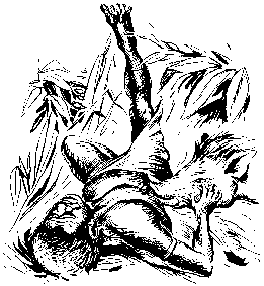
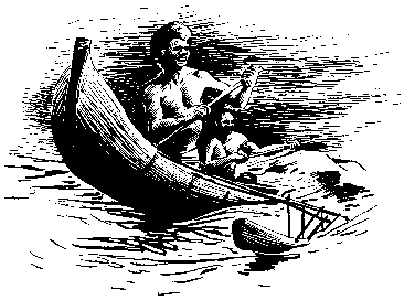
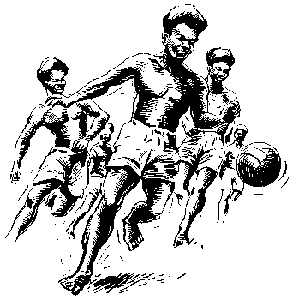
Powys PAWIDU WINS HIS GOAL "Help!" Help!" Pawidu stopped walking and listened carefully. Where did the cry come from? There it was again! "Help me! I'm drowning!" Pawidu ran quickly along the bush path towards the beach. There, at the mouth of the channel where the deep fast stream entered the sea, a boy was struggling against the powerful waves . The strong north-west wind drove another white breaker towards the beach. The water in the channel was checked and pushed back towards the lagoon it had come from. The boy was dragged with it, fighting hard to keep his head above water. Pawidu threw off his loin-cloth as he ran over the wet sand. Diving into the water, he let himself be carried with the sea water still moving up to the lagoon. But the waves had nearly stopped, and now the water rushed again from the lagoon. Pawidu was carried down towards the sea towards the drowning boy. "I'm coming to help you!" he shouted, but the wind tore his words away. The boy was only five yards away, but Pawidu saw his head only now and again. "He must be too weak to fight the water any more," he thought. "I must try harder and get him before the next wave breaks." Although Pawidu was a very fat boy, he could swim very strongly. Swimming with the current of the lagoon water, he caught hold of the boy's hair. The boy's eyes were closed, and Pawidu fought to keep the head above water. "How can we get to the bank?" The water was taking them past the fringe of the beach and out to the open sea. Suddenly Pawidu threw out his hand and grabbed a tree branch dangling over the bank. For a moment he rested. He had walked all night from the town to get back to the village before dark. The walk plus his efforts in the water had made him tired. Using all his strength he hoisted the boy on to the bank above and pulled himself up after him. After a while the boy opened his eyes. "You saved me from drowning," he said. He was a nervous boy, and spoke with a stutter. "How did you fall into the water?" asked Pawidu. "I was trying to get back to my village, Katan, before sunset. The quickest way is across the channel. But the stream was too strong for me. I was lucky you were here to save me." The fat boy was curious. "Katan is the new village near Kolomai isn't it?" "Yes," replied the boy. My people used to live up in the mountains. After the war, the government asked us all to move to the coast and help the Kolomai people with their co-operative society. My father Iranu is the headman of Katan. My name is Alingi." "I am Pawidu. I belong to Kolomai, but my uncle has been working in the town for two years. I went to the town with him and went to the station school there." "Have you finished school now?" asked Alingi. "Oh, no," Pawidu laughed. "I think I shall never finish. My school work is very bad, and there were many interesting things to do in town. But now my uncle is coming back to Kolomai again, and I want to go to the Village Higher School there." It was now four o'clock. The north-west wind had dropped for a while, though the sky was still heavy with rain. Pawidu and Alingi must hurry if they were to reach their village before nightfall. This time they did not try the quick way across the channel. It was too dangerous. There was another track an hour's walk away, in behind the lagoon. They found this track and followed it to Kolomai, and Katan. Early next morning Pawidu walked from his Uncle's house in Kolomai to the village Higher School. He was very anxious to become a pupil there. He knew he must work hard but it would be better here than in the town. There were not so many distractions in the village and he would study at night. There were four schoolhouses and four dormitories. Between them were two play areas. One had goalposts at either end, and the other had a cricket pitch at the centre. Pawidu grinned. "I hope they let me play soccer," he thought. "That must be Joseph's house up on the hill above the school." Alingi had told him the day before about Joseph, the new teacher in charge, from Bougainville. Pawidu started to climb the hill. On a piece of flat ground half way up was another house standing on piles. He wanted to be sure that this was not Joseph's house. He coughed loudly to attract attention. No reply. He coughed again. He was sure there was someone inside the house for he could hear movements. "Why don't they answer?" he wondered. He shouted loudly. The door opened. An old man came out on to the verandah. He looked angry. "What do you want?" barked the old man. "I want to see Joseph. Are you Joseph?" "Joseph lives in the house up on top. But he won't see you." Pawidu was surprised. "Why not?" he asked. "I want to go to his school." "You want to come to school!" The man laughed, but there was no laughter in his eyes. He was still angry. "What would you do at his school? You're fat like a pig and you act like one coughing and shouting outside my house. Haven't you learned to knock on a door if you want to see someone?" The fat boy was ashamed and a little afraid now. "I know that is European custom," he said quietly. "It's our custom too," said the old man, and went back into his house. Pawidu stood thinking. He was worried. He did not know what to do. The old man had said he was like a pig. He felt too ashamed and afraid now to go up to Joseph's house. Perhaps Joseph would be angry with him too. Some schoolboys were beginning to arrive for the morning's lessons. Some of them sat on the ground talking, others kicked a football round the soccer field. Pawidu walked slowly down the hill towards the school. He felt he should go home again, but he wanted very much to join this school. As he came near the schoolroom he heard the boys use the word "Alingi." He stopped. The four boys did not see Pawidu behind the schoolroom, and he did not want them to see him. Now he could hear what they were saying. Their words made him feel very angry. "Alingi was nearly drowned," said one boy. His three friends laughed. "Alingi's the son of a headman, but he can't even swim." "None of the mountain people can swim," said another boy. The group laughed again. "Look! Here comes Alingi now!" Pawidu heard the boys shout to Alingi and call him some bad names. Pawidu walked into the classroom. "Stop saying those bad things!" he said to the boys. They looked surprised for a moment, then they laughed. "It's none of your business!" said one. "Who are you anyway?" "I'm Alingi's friend," replied the fat boy. "If you say any more bad things about him, I'll make you sorry." The group of boys thought this was very funny. Their leader jeered. "Alingi is a woman, and if you're his friend you must be one too!" Pawidu leaped at the boy, his fists flying. The two boys fought savagely, but Pawidu was angry and very strong. The boy's friends caught Pawidu from behind but he struggled free. Now he was fighting all four of them, and it was too much for him. They knocked him on the floor and started kicking him. Cruel blows caught him on the head and body. Pawidu's head was swimming and he could scarcely see. He tried to get up from the ground but could not. "Soon they'll kill me," he thought. Suddenly, as though from a hundred miles away, he heard a voice, a new voice. "Stop!" said the voice. The kicking stopped. Pawidu tried to open his eyes. Now there was much talking and someone was bending over him. "Carry this boy to the office," said the voice. "Easy now-he's badly hurt." Pawidu felt himself lifted roughly from the ground. The two carriers groaned under his weight. He opened his eyes and quickly shut them again. He felt very sick and all his body was aching. Now they were in the office and the fat boy was let down on to a blanket on the floor. The two carriers left. Pawidu opened his eyes again and was sick. But he felt a little better now. He looked up at the owner of the voice. He saw a tall man with. a very black skin. The man looked sorry. "This must be Joseph," thought Pawidu. "I'm sorry I made the floor dirty," he said quietly. Joseph smiled. "That's all right. You've been in a big fight. I think we are the people who should be sorry." Joseph bathed Pawidu's cuts with disinfectant, and bandaged the worst ones. "You must have a day's rest before you come to school. You can start tomorrow." Pawidu was surprised that Joseph knew all about him. "Oh, yes," said Joseph, "Alingi has told me your story. Alingi is very ashamed that you fought for him. Anyway, sleep in your house today, and tomorrow we'll try to straighten things out." Next day Pawidu started at his new school. He made many mistakes in class but he worked hard. Alingi was in Joseph's class, but Pawidu had a different teacher. Once or twice he saw Alingi, but Alingi looked away so that he would not speak to him. After school the fat boy went up to see Joseph. He spoke to Joseph about Alingi. "I think Alingi is still ashamed," he said. "Alingi is a very shy boy, and of course he comes from the mountains," replied Joseph. There was always some trouble between the Katan people from the mountains, and the Kolomai people who belonged to the coast. "Next month I am taking a football team up to the mountains to play soccer against the mission schoolboys. I hope that will help the mountain people and the coast people to become friends." Pawidu looked wistful. "I suppose the soccer team is chosen already. I used to play soccer in the town team." "We can try you in our school team. We need a good goalkeeper. There's football practice this afternoon. Try not to fight, though." The schoolboys were angry when they heard Pawidu was to practice with them. They deliberately made it hard for him by trying to kick goals all the time. But Pawidu was really a first class player after two years in the town and he was ready for them. Time after time the ball came flying towards him from this angle or that. And time after time Pawidu was able to send it back into the field without a goal being scored. Time after time they jostled him and tried to make him fight. But Pawidu did not lose his temper. He remembered what Joseph had told him. He knew he must show himself to be a good player before the team would accept him. Joseph watched Pawidu's play closely and decided he would be an excellent goalkeeper for their team. He knew the schoolboys thought the same way and would slowly accept Pawidu. Pawidu walked back to his village house feeling very tired after the game. But he was happy. The schoolboys made him play hard, but he was used to that and enjoyed it. They were angry with him, but already he knew that one or two were ready to be friends with him. Pawidu thought he would go to bed early that night. But first he had to think about his dinner. Then he would read by lamplight through the English lessons he had learned during the day. It was too late now to get food from his Uncle's garden. He would have liked some yams and cabbage with perhaps some fish. But rice would have to do tonight. He was sitting on his verandah when he heard voices coming from the bush track among the trees. One voice was that of a girl. "I wonder who this is," Pawidu said to himself. A young man and a girl appeared out of the bush and walked up to the house. The girl had a big string bag hanging from her head on to her back. In it were some fish, sweet potatoes, cabbage and a few mushrooms. The young man carried a sago leaf basket in his hand. He greeted Pawidu and handed him the basket. "Here are some yams from Iranu's garden." "Iranu? Oh, yes, he's Alingi's father." "Yes." The young man smiled. "I'm Alingi's cousin and this is his sister. Alingi wants to give you this food in return for all you have done for him." "Thank you very much. Would Alingi like to have some food with me tonight?" "I'll ask him," said Alingi's cousin. "He's very ashamed and he may not come. But I'll ask him. This girl will come back and cook for you." The two left and not long afterwards Alingi came, a little shy but grinning from ear to ear. Pawidu and Alingi shook hands. Alingi's shame was forgotten. The two boys knew they would be friends for a long time. * * * * "We might take a pig with us to Katan," said Joseph next day. "But there are no wild pigs near the coast. Now that many mountain people live down here, all the bush pigs have been caught and killed already." Where could Joseph find a pig? It would cost ten pounds for a big village pig. Ten pounds is a lot of money. Also the village people did not like Joseph, so they would not help him with a pig. "Let's catch a wild pig," suggested Pawidu. "We'd need two or three people to help. The mission shootboy up at mountain Katan is an old friend of mine. I think he'll bring his shotgun in case the pig's dangerous. And he knows how to catch a wild pig in a trap too." Pawidu sent a message to his friend the shootboy at Katan. He wanted him to ask the European missionary at Katan if he might help them hunt a wild pig. Alingi and one other schoolboy promised to go too. Early on Saturday morning Joseph, Pawidu, Alingi and the other boy climbed the mountain paths to Katan. It was very hot when they reached the mountain village. They rested in the shootboy's house and drank coconut milk. The shootboy told them he and his friends had dug a deep hole in a place where there were many pig marks. They had covered the hole with branches, leaves and earth. Then a wild pig might walk across the trap and break the covering with his weight. "If we don't find a pig in the trap, we'll have to go into the bush and drive a pig into it!" The five followed a path through old gardens, then came to a river. On the other side was the jungle: tall trees and thick undergrowth and a little-used track. The shootboy warned them to walk quietly now, for there were pigs nearby and soon they would reach the pig trap. They moved carefully, noting places where pigs had rooted up the ground. The shootboy held up his hand. "Quiet." From just ahead came the sound of an animal grunting. The shootboy put his finger to his lips to signal the others to keep very quiet. Then alone he glided along the track towards the sound. Suddenly, he stopped, pointing to the pig. He beckoned to the four to follow him. "The pig's along there near the trap," he whispered. "Let's try to drive him into it. If we make a lot of noise he may run straight along the path into the trap. When I say the word, we'll all shout out and stamp our feet." As they made the noise they saw the pig jump into the air with fright. It raced along the track and then stopped, sniffing suspiciously, at the edge of the trap. Then everything happened quickly. People scattered in all directions as the pig turned and charged towards them. All except poor Pawidu! He tried to jump out of the pig's way but tripped over a tree root and fell heavily to the path. The pig attacked Pawidu as he tried to get up. It gored him with its tusk. Pawidu screamed as the tusk cut into his thigh and the red blood ran from the gash. Pawidu rolled off the path groaning with pain. Now the pig attacked again, making for the fat boy's head. He tried desperately to reach a tree branch but his injured leg would not hold his weight. "I'm finished!" thought Pawidu and fell in a heap with the pig on top of him. A shotgun fired. The pig quivered, sighed, lay still. The shootboy had killed it. Already Joseph had run to where Pawidu lay. Quickly tearing a strip from his shirt he bound it tightly round Pawidu's leg to stop the bleeding. "We'll have to carry him carefully but quickly down to the airstrip," he said. "If a doctor doesn't see him soon, he may die." Alingi looked worried. "I'll run on ahead and tell the missionary at the beach." "Yes." Joseph nodded in agreement. "Ask him to send a wireless message if he can. But hurry! If we want a plane for Pawidu, we must get it before sunset." Alingi ran on along the track, while Joseph and the others came more slowly behind, carrying Pawidu. Near the coast the north-west wind was blowing strongly, bringing heavy dark clouds with it again. Though the sun was high in the sky, its light was shut out by the clouds. As Alingi came running near the missionary's house beside the beach, rain was falling. Alingi saw the missionary's servant walking along the beach. "Is the missionary at home?" he shouted to him. The servant shook his head. "He left this morning to walk to the church at Warahini." Alingi groaned. Warahini was fifteen miles further along the coast. Even if he ran all the way it would be sunset before he could get there. Then the missionary must walk back to send the wireless message. The wireless station in town was closed overnight. So it would be next morning before they could ask for a plane to come in. Alingi sat on the beach and wept. Pawidu his friend would die. He, Alingi, could do nothing to help him! If only he knew how to use the wireless! But only the missionary knew how to send a message by wireless. Was there anything he could do to help Pawidu? He tried hard to think of something the missionary once told him. What was it the missionary had said? That was it! If a plane is passing over the airstrip it will land if the pilot sees a red loin cloth between two white ones. He looked at the sky. So low and heavy were the clouds that no pilot could see the airstrip even if a plane did fly over. But it was the only chance. He headed back to the village not running now but slowly because so disappointed. His own loin cloth was white. He must fetch a red one and another white one to lay on the airstrip. Some time later Joseph and the others arrived, carrying Pawidu. Pawidu was in great pain and had lost much blood. Joseph loosened the tourniquet for a few minutes so Pawidu's leg would not become paralyzed. He looked worried when Alingi told him about the wireless. "I hope a plane comes. I'm afraid Pawidu may die if we can't get him to hospital." The rain poured down. "No plane will come this afternoon. We might carry him along the track to town, but we would have to walk all night. And the rain may make the big river flood so we can't get across." He sighed and shook his head. "This has been a most unlucky day. Poor Pawidu has been unlucky ever since he came to Kolomai." Pawidu was only semi-conscious. Joseph sat for a long time without saying a word, listening, watching, sometimes adjusting the tourniquet on Pawidu's thigh. But no plane came. Rain squalls came and went but the sky remained dark. Joseph glanced at his watch--five o'clock. In a little more than an hour it would be dark. The beach was a hundred yards from the airstrip. He walked down towards the sea, and studied the water in the direction of the town. The wind drove the sea up the beach and beyond so that water lapped the piles of the mission settlement houses. Joseph looked at a canoe. "I wonder?" he thought. He ran back to the hut where Pawidu lay. "Can you sail a canoe?" he asked Alingi. Alingi looked surprised. "Canoe?" No. My people are not a sea people. We come from the mountains. True, there's a canoe on the beach. The people use it to take rice into town during the south-east season. But we can't sail a canoe in this bad weather." Joseph grinned. "In Bougainville I often sailed a canoe. I'd like to try it. I think it's the only way to get Pawidu to hospital quickly. Will you come with me?" "But we'll all be drowned in that rough sea. Isn't it better to wait for a plane?" "No plane will come now. We could get Pawidu into hospital by nine o'clock in the canoe." Alingi looked afraid. "Travel at night in that sea?" "Afraid of spirits?" laughed Joseph. "We mountain people know that many spirits live in dangerous places, and the sea is full of them." Alingi's face grew red with shame. "I know you don't believe in them, but I'm very afraid." "I understand. Don't be ashamed of your fear. But if you won't come with me I must go alone." "Oh, no," Alingi protested. "Pawidu has saved my life. He's my friend and you are my friend. I must go with you." "Good man!" Joseph put his arm round the boy's shoulder. "We'll be all right. Now help me take Pawidu down to the canoe." Alingi felt sick, cold and frightened. The night was black, the wind tore fiercely at the yelled boat and the three people in it. Overhead the clouds raced, clearing from time to time to show stars twinkling before being covered again. The canoe moved along like a mad thing, rising, falling, shuddering as it fought wave after wave. Joseph handled the boat like a master. Alingi wondered how he knew where he was going. He could see nothing, but the teacher from Bougainville kept the wind behind him. Now and again he glanced up as the stars appeared, reading them like a map. Alingi switched on a torch they had brought with them, and studied Pawidu. He lay tied to the boat platform, pale and still. But there was not time for Alingi to sit and worry. The canoe was well built, the outrigger keeping it steady in the water, the narrow hull not shipping much water. Even so the rough sea splashing in would soon have filled the hull, had Alingi not baled out the water constantly. Suddenly he felt Joseph's hand on his shoulder. Joseph had to shout close to his ear to make himself heard above the noise of the wind and the waves. "Look! Can you see something over there?" Alingi peered through the blackness and saw nothing. But what was that? It could be a light almost hidden by the rain and mist, appearing, then dissappearing. "It's a light at the Government outstation," yelled Joseph. "We must change course now, We must both paddle hard so we won't be carried past." The light was still well ahead to starboard. But the wind and current were so strong that they must try now to make for land. Alingi's arm ached as he threshed the water with his paddle-on, on and on. This was his first try at paddling a canoe. He felt weak beside Joseph who kept on paddling steadily-it seemed without any effort-hour after hour. Now and again they had to stop paddling to bale out the water. Then on again until Alingi lost track of time and felt indeed that he couldn't care if the boat did sink. He started as though he had awakened from a deep sleep. But he had not been asleep-he was still paddling as though he were a machine. Why then had he started? Then he knew that a new sound was coming to his ears. It was the sound of breakers. His heart sank. He knew of course, that they must cross the reef to reach the station, but he had not worried. Now he was afraid. In a rough sea like this it would be so easy for the canoe to be caught on the jagged reef edge, and slowly be broken up by the waves, pounding on the reef. And, Alingi could not swim. Neither could the helpless Pawidu! Joseph could not help both of them if they were thrown into the sea. In fact it would be hard enough for even a man like Joseph to look after himself on the reef on a night like this. Alingi said a prayer for all three of them, and for the canoe. The noise grew louder and then suddenly was all around them. But Joseph again proved himself a first-rate seaman. He knew a passage through the reef, and by wonderful seamanship, and a lot of luck, he had brought the canoe straight to it. Inside the reef the water was calmer. Soon they steered their craft to a small strip of sand at the foot of the headland on which the station was built. Tired though they were, they jumped on to the tiny beach, dragging the canoe as far as they could above the tideline. Pawidu groaned as they untied him and lifted him off the canoe platform. Then they started to carry him up the steep narrow path leading to the top of the headland. Soon a startled European doctor was examining Pawidu at the hospital. * * * * The day of the big football match was fine and clear. Before the sun rose the school team was awake and ready to walk to the mountain village. "Where's Alingi?" asked Joseph. Alingi had promised to play in Pawidu's place as goalkeeper. But at six o'clock he had not come to the school. Joseph walked quickly to Alingi's house in the village. The village people were astir. Most of them had decided to go and watch the match too. It was to be an important day with a feast and a dance at night. Iranu the headman met Joseph outside the house. He looked worried. "I have had bad news," he said before Joseph had spoken. "Alingi is very sick. He has a fever." "That's very bad," said Joseph. "I know Alingi's been sick since the night we took Pawidu in to the station. We'll have to find someone else to be goalkeeper." He did not stay long. He knew the schoolboys were impatient to be on the move. Soon afterwards the party started along the track with some of the village people. The sun swung slowly overhead. It was high in the sky when they reached the old Katan village. Greetings were exchanged with old friends, coconuts offered and accepted. A small meal was prepared for the visitors before settling down to the main business of the day: soccer. About two in the afternoon, the two teams faced one another on the field beside the river. Joseph had chosen one schoolboy as goalkeeper to take Alingi's place. The game started quickly with the coast boys gaining the advantage. Joseph had taught them well, and they had little trouble in steering the ball through and around the mountain team. One very good forward, Ronil, had the ball near the goal in the first minute of play. Only the Katan goalkeeper opposed him. The Katan goalkeeper was only a small fellow and Ronil grinned. "This will be easy!" he thought. He made a beautiful kick and the ball sailed towards the goal. But suddenly the little goalkeeper was in line with the ball, leaping like a wallaby in a powerful spring. His long arms reached high into the air, the ball hit his hands hard, shuddered, fell to the ground outside the goal and rolled away. The coast team scarcely believed their eyes. It had been a sure goal but this little goalkeeper had beaten them as though by magic. Well, it would not happen again. The ball was thrown into play once more. The Katan team managed to drive the ball past the halfway line. But Ronil was there again, and soon had it travelling towards the little goalkeeper a second time. This time Ronil kicked the ball high. He couldn't possibly reach that one. But he did! The goalie took off and soared upward like a rocket. Again his long arms were there-the ball shuddered and fell. No goal! The game went on like this for about twenty minutes. Neither side scored a goal though Ronil and one or two others made good kicks towards it. But every time the Katan goalkeeper foiled them. Then the game began to change. The teams were well matched for size and strength. The coast boys, however, were a little tired from their walk while the mountain team was fresh. The play moved gradually towards the coast goal. The coast goalie whom Joseph had chosen at the last minute was no match for the Katan play now. A Katan player kicked the ball from halfway down the field. It flew towards the goal and the goalkeeper failed to stop it. One goal to Katan! Ten minutes to half time. The coast boys fought hard, but they were tired, and twice the Katan team kicked towards the goal without scoring. Then just before the half-time whistle the ball streaked towards the posts. The goalie wasn't there. Half time and two goals to Katan. The coast people groaned. It looked as though the mountain team would beat them. If only Pawidu were here as goalkeeper. They had laughed at Pawidu and fought him when first he had come to school. Now they wished he was there to help them. Joseph wondered how Pawidu was getting on in hospital. He was a little disappointed that his school had lost the first half. But he was not worried. It was after all only a game and its aim the friendship of mountain and coast people. He walked over to the school team and advised on the tactics to follow in the second half. The goalkeeper looked ashamed. "I think you should choose someone else as keeper," he whispered. "Whom do you suggest?" asked Joseph. "Pawidu," answered the boy. "Pawidu?" Joseph laughed. "Yes, if we shout loudly enough, he may hear us in hospital." "I can hear you." It was Pawidu! Joseph could not believe his eyes. "You!" was all he could say. Pawidu grinned. "I thought you might need me, so I came home. The doctor said I could come. I thought I'd be late." Pawidu's leg was still bandaged, and he walked with a slight limp. But he felt strong enough to play the second half if the mountain team consented. Alingi had come too, though he was still sick with fever. He was too sick to play but he wanted to see his friend Pawidu play. During the second half of the match, play changed completely. Pawidu was a rock and no ball could pass him. Not that the mountain team had a chance to challenge the rock. For Pawidu's return acted like betel nut on the coast schoolboys. Their bodies felt light. They felt happy-how could they lose the match? Their hero Pawidu was back. Twice they forced the ball through the opposing team and now Ronil had found a way to beat the mountain goalkeeper, good though he was. It was sheer trickery, of course, but brains as well as bodies are necessary in a struggle of this kind. A rush down the middle of the field, then a faltering as the goal came near. The goalkeeper was ready. But he dropped his guard as the coast boys allowed themselves to be driven slightly to the sidelines. Ronil waited his chance. The goalie was away from the posts now. The ball was Ronil's near the sideline. Quick aim, a mighty kick-and a brilliant shot right between the posts! Ronil managed this twice-two goals in all-but they knew the mountain team would not allow it a third time. It grew hate-only a few minutes play left. How could they get their third goal and win the match? The referee was already looking at his watch ready to raise his whistle to signal the end of the match. Suddenly from centerfield acting as one man the coast team streaked the ball towards the goal. A kick towards the goal-but the goalkeeper was there ready. And so was Ronil! No kick, but "head way." Ronil headed the ball down past the goalie's feet. The whistle blew. The match was over. Coast school had won, but both teams had played well. There was no jealousy. Night fell. The moon rose. Portions of pig, sweet potatoes, coconut, fish and cabbage to make the mouth water changed hands. Old friendships were renewed round the fires. Betel nut was offered and accepted. The dancers skipped and chanted in their endless circle. Pawidu, Joseph and Alingi sat and watched and talked far into the night. TELL ME 1. How did Pawidu first meet Alingi?
|